

The Busk
Disability, Disposability, and the Machinery of Forced Visibility

Every morning I wake up and perform myself into existence.
I am writing this from a motel room we cannot afford past this morning. This analysis is my labor; your solidarity is our survival.
This is not metaphor. This is the literal condition of survival under a system that has decided I am simultaneously worthless and obligated to prove my worthiness constantly, publicly, in real time, with receipts.
I am a disabled person. I am the primary caregiver in a multigenerational household of six adults: my elderly mother with heart failure, who uses a wheelchair. My sister with thyroid disorder and Type 2 Diabetes, who is a brain stem stroke survivor. My three adult children. We have been cycling through hotel rooms since July 2025 (Studio 6, SureStay, Ramada by Wyndham) paying hundreds of dollars a week out of money we do not have while a billion-dollar insurance company and two failed ECM providers and one state agency continue to run out the clock on our survival.
I have a State Fair Hearing scheduled for March 30, 2026. I have regulatory complaints with DHCS, DMHC, DSS, and a DOJ Civil Rights Division complaint filed. I have a legal record that documents, precisely and exhaustively, every failure, every misrepresentation, every mechanism of abandonment.
And I wake up every morning and I busk.
What this means.
Busking is street performance. The busker stands in public space (vulnerable, visible, exposed) and offers something: music, art, presence. Hoping that passersby will be moved enough, or guilty enough, or simply kind enough, to give. The busker has no wages. No employer obligation. No safety net beneath the safety net. The busker must be perpetually appealing. Always on. Always translating their need into something palatable enough that the audience doesn’t look away.
I am not on a street corner. I am inside your phone. And the performance is not music, it is my analysis, my theoretical frameworks, my intellectual labor, my truth-telling about genocide and structural violence and systems designed to destroy people like me. And the busking is, right now, the only mechanism I have left to survive.
This is not sustainable.
More importantly, this should not be required.
The Machinery
Let me name how we got here, because the personal story is always also structural, and I need you to understand that what is happening to this household is not a personal failure. It is policy. It is design. It is intentional.
In August 2025, I was enrolled in CalAIM Enhanced Care Management services. ECM is theoretically meant to coordinate care for high-need individuals, to address the social determinants of health, provide housing support, benefit navigation, medical care coordination. It sounds like a safety net. What it is, in practice, is a mechanism of control disguised as care.
Health Net is my MCO. They contracted with three separate ECM providers: Serene Health, EA Family Services, and Community Works, the third of whom has yet to provide any services at all. The first two failed through active misrepresentation, claiming to have delivered services continuously and in full. They had not. Health Net itself then told the State Hearings Division that a housing per diem had already been granted through January 27, 2027. It had not been provided. The state used this phantom per diem claim to deny my third request for expedited hearing status, ruling there was “insufficient nexus” between the denial and medical jeopardy. The record documents otherwise.
Health Net also obstructed access to the care coordination portal, a potential violation of the 21st Century Cures Act’s information-blocking provisions. They are not a passive administrator. They are an active participant in the abandonment.
Meanwhile, Health Net declined to provide the transitional rent benefit they are authorized to provide under HSC § 1367.01(h)(2), 28 CCR § 1300.67.2.2, and APL 21-011. They did not provide it when I requested it, via self-referral. They did not provide it when I appealed. And the pattern of who receives this benefit and who does not is not random.
This is disability violence with paperwork. This is abandonment administered through a bureaucratic interface. This is what it looks like when systems designed to “help” disabled people are actually designed to extract resources from disabled people while creating the illusion of care.
The constructive displacement from our long-term housing at Chesapeake Commons in July 2025 set all of this in motion. What followed was not a series of unfortunate events. It was a predictable outcome of a system that has no real mechanism for keeping disabled people housed, and every incentive to deny it when they fail.
My household has paid out of pocket for six months of hotel stays. Studio 6. SureStay. Ramada by Wyndham. Hundreds of dollars a week from money we do not have. Money that should be going to food, to medical care, to the daily operations of keeping disabled people alive.
And the disability piece matters here in a specific way: the way the system weaponizes disability is not accidental.
Disabled people are told we are expensive. We are told we must prove our need. We are told that our access requirements are luxuries, accommodations, special favors. We are told that we should be grateful for whatever crumbs we receive. And when we advocate for ourselves (when we file complaints, when we pursue legal remedies, when we demand what we are legally entitled to) we are told we are ungrateful, difficult, litigious.
But here is what is actually happening: we are being systematically starved of resources while being simultaneously made responsible for our own survival. The system creates the crisis. Then it demands that we perform gratitude for the partial solution. Then it abandons us when we refuse to perform.
This is not disability services. This is disability violence.
The Toll
What it costs to busk every day.
I wake up. My body is tired. I am a disabled person with complex medical needs, a genetic architecture requiring specific micronutrient management, a trauma history, an ongoing legal fight, and a household of six adults whose survival is entangled with mine. I have grief. I have rage. I have the particular exhaustion of a person who has been fighting the same fight, through the same bureaucratic labyrinths, for months.
And then I open my iPad.
Because if I don’t open my iPad, the writing doesn’t happen. If the writing doesn’t happen, the analysis doesn’t reach you. If the analysis doesn’t reach you, you don’t contribute. If you don’t contribute, we don’t eat.
So I produce intellectual labor at the highest level. I develop frameworks that scholars will use; limoscide, paisicide, iatrocide, the Genospectra Framework. I analyze genocide. I document media distortion. I investigate structures of power. I write with precision and rigor and moral clarity. I do this while managing a household. While managing a health crisis. While managing a legal fight. While managing the constant low-level trauma of not knowing where we will be sleeping the next day.
This is the busk. This is what it looks like.
This is not an inspiring story about resilience. Resilience is what we call it when systems fail people and those people survive anyway, so the system doesn’t have to be accountable for the failure. I am not inspiring. I am exhausted. And the exhaustion is a policy outcome.


What Solidarity Actually Requires
I have seen what happens when people confuse charity with solidarity, so I need to be direct.
Charity is what you give when you feel guilty. It requires the recipient to be humble, grateful, non-threatening. It requires us to make our need palatable. It asks us to perform suffering in a register that makes you comfortable enough to give. Charity leaves the systems intact.
Solidarity is something else entirely.
Solidarity is the recognition that we are in this together. That the systems that are destroying me are designed to destroy you too, just on a different timeline, with different mechanisms, depending on which bodies and minds the state has decided are expendable. Solidarity is the understanding that my survival is connected to your survival. That when disabled people are systematically starved of resources, when housing is a commodity rather than a right, when care is a profit center rather than a human function, that affects all of us.
Solidarity is not charity. Solidarity is investment in a world where this doesn’t happen. If this analysis has clarified the systems you live within, recognize that this clarity has a cost. I am providing the map; I am asking you to fuel the journey.
Solidarity is not a feeling. It is a practice. It is resource transfer. It is showing up.
So here is what I need, not as a supplicant, not as a beggar, but as someone doing the work who is running out of runway:
Immediate survival funds. Not next month. Now. We are looking at displacement in real time. The hotel funding is running out. The fair hearing is March 30. The system is designed to wear people down until they break.
Sustained monthly contributions. Not as charity, as subscription. As recognition that the intellectual labor being produced here is valuable and should be resourced like it is valuable. The work doesn’t stop when the crisis passes. Neither should the support.
Understanding. Read about CalAIM. Read about the Knox-Keene framework. Read about how managed care organizations operate. Understand that what happened to this household is not a glitch. It is a feature.
Action. If you are in CalAIM and experiencing service failures, file with DHCS, DMHC, your local health department. Build a paper trail. Make the pattern undeniable. Call your representatives. Name the harm by its name.
Sharing. Tell people what is happening. Not as a sad story. As a structural analysis. This is not rare. This is the logic of the system. They might be next.
The Path Forward
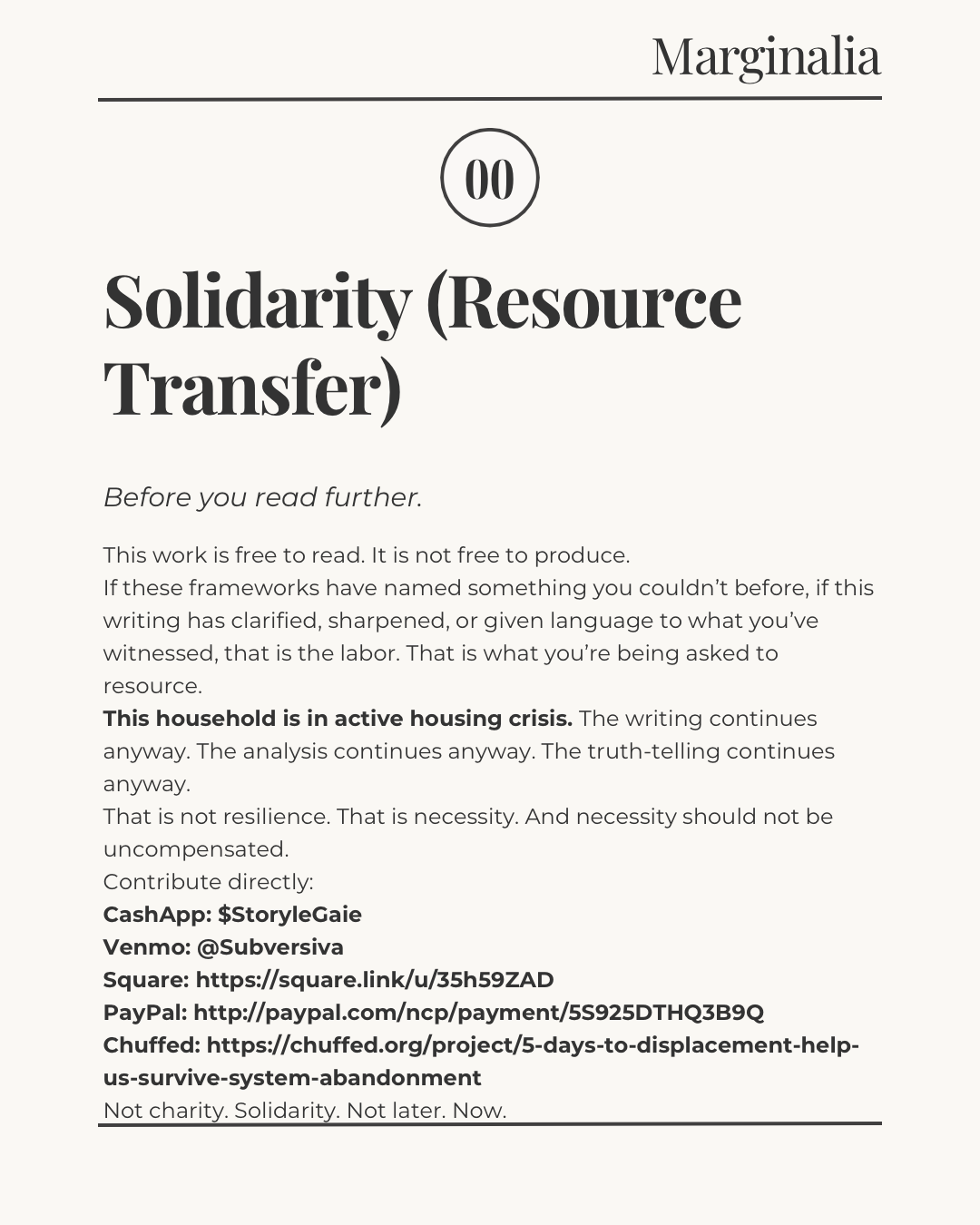
Contribute directly:
CashApp: $StoryleGaie
Venmo: @Subversiva
Square: https://square.link/u/35h59ZAD
Chuffed: https://chuffed.org/project/5-days-to-displacement-help-us-survive-system-abandonment
The Real Ask
I am not asking you to save me. I am not performing a victimhood narrative that casts you as hero. I am not asking for the kind of charity that makes you feel generous while leaving the machinery untouched.
I am asking you to understand that the machinery is designed to make disabled people invisible until we are useful, and disposable once we are not. I am asking you to understand that housing instability is not a personal failing, it is a policy outcome with names attached to it, institutions responsible for it, and legal remedies being pursued against it. I am asking you to understand that when I busk my intellectual labor every day to keep six people alive, that is not inspiring. It is a sign that the system has failed, completely and by design.
I am asking you to act like you believe that disabled people deserve survival without performance.
I am asking you to understand that solidarity means resource transfer.
I am asking you to give (directly, without guilt, without requiring me to make the ask more comfortable) because it is right.
And I am asking you to understand that this is bigger than this household. That every disabled person in this country is being asked to busk in different ways. That the machinery runs on our exhaustion. That the only way out is to stop feeding the machinery and start feeding each other.
So give. Or don’t. But understand what your choice means.
Choosing not to give is choosing to let the system work as designed.
Choosing to give is choosing to believe that disabled people deserve to survive without performing for it.
There is no neutral position here. There never was.
I am Story leGaïe. Disabled person. Primary caregiver. Internationalist, genocide scholar, writer. I am doing the work. I am running out of runway. I need your help.
Not charity. Solidarity.
Not performance. Practice.
Not later. Now.